I've Avoided Discussion of the Mitchell Report
Until now that is, because I've felt all along that there's a complete lack of credible evidence and to name names without regard to anything substantial is wrong, especially when the investigation is led by the Director of the Boston Red Sox, and lo and behold the report's release allows the Boston Globe to run headlines like "No Current Sox Fingered."
Tim Marchman of the NY Sun has a really good take on the report. You can find it here. Some excerpts follow:
To understand the importance of Senator George Mitchell's investigation into baseball's drug scandals, issued today after two years of frenzied anticipation, one must understand that Mitchell is not a neutral party.
Because the truth is usually right out in the open, it is no surprise to find a list of all the conflicts of interest that prevent Mitchell from credibly playing any independent role in baseball tucked away near the end of his voluminous report. As a consultant to Boston Red Sox ownership, a former director of the Florida Marlins, and former chairman of Disney at a time when it owned both the Anaheim Angels and ESPN, Mitchell is a member of baseball management as surely as anyone now living.
More crucially, he served with former Federal Reserve chairman Paul Volcker, columnist George Will, and Yale president Richard Levin on the 2000 Blue Ribbon commission. That group produced a notoriously owner-friendly report on baseball economics that used cooked numbers to make a case for various mechanisms meant to suppress player salaries. It laid the ground for the biggest shift in power between owners and players since the 1970s, and set a template for how to do so: Establish a nominally independent commission with ties to Congress, propose owner-friendly policies, and then watch as Congress hammers the players into submission. In 2000, the Senate actually found time to hold hearings on competitive balance in baseball, and it didn't take long for owners to force the union to accept many of the Blue Ribbon panel's recommendations.
With this background, Mitchell is hardly an onlooker, uninvolved in the sport's inner workings; he's been one of the most powerful men in the game for many years. In his report, he blithely asserts that he is "confident that none of these matters affected my ability to conduct an investigation that was thorough, impartial, and fair," but while his investigation may have been all of these things, his report is none of them. Self-contradicting, naive, and radical all at once, it could prove far more damaging to baseball than any tainted home run record.
For most, the main takeaway will be the list of 77 names of alleged drug users. Headlined by the Yankees' Roger Clemens and Andy Pettitte and the Houston Astros' Miguel Tejada, the list takes in everyone from three former Mets catchers to Eric Gagne, and in its sheer weight seems to confirm both the most salacious speculation about what Mitchell would uncover and the massive scope of the drug problem. More closely examined, it does neither, and in fact reveals how shockingly little Mitchell found.
What Mitchell offers, then, is not new information, but lurid detail. ("Clemens said that he was not able to inject himself, and he asked for McNamee's help... McNamee injected Clemens approximately four times in the buttocks over a several-week period with needles that Clemens provided.") This detail came not from Mitchell's own commission, but from the access the federal government provided to witnesses and suspects in ongoing drug investigations. Conditioning coach Brian McNamee and drug dealer Kirk Radomski were both interviewed with federal agents participating. Radomski, then working out a plea bargaining arrangement with a U.S. attorney, was warned that giving Mitchell false statements would subject to criminal penalty and a harsher sentence.
Federal law enforcement didn't need to tie Mitchell's inquiry in to a plea bargaining agreement, and would almost certainly not have done so for any random collection of citizens holding a private inquiry into steroid use. Such a decision is inherently political, involving as it does relative power, which was of course the genius of appointing Mitchell: it allowed baseball to leverage the credibility he earned in a career as a distinguished senator and diplomat into access to federal power. To what end, though, does any of this work?
[For]nearly half the players on Mitchell's list, their inclusion is simply gratuitous. Sixteen names were simply scooped up from recent media reports on a federal investigation into online drug trafficking, eight were names that came out in the Balco scandal, and nearly a dozen more had previously come out one way or another. Some, like Ryan Franklin, had even failed drug tests. This leaves us with around 40 names who come as surprises. Some of them truly great players, like Kevin Brown; most are obscure journeymen, like Phil Hiatt. Against some of them there is impossibly credible evidence; against others, hardly anything at all.
The real takeaway here, though, is that despite using questionable means to questionable ends, Mitchell can present literally no evidence of his key claim that "the use of steroids in Major League Baseball was widespread." This assertion is stated flatly, as fact, but his entire report contradicts it.
Mitchell at one point, for instance, references several lurid estimates of how many ballplayers have used steroids, ranging from 20% to "at least half," to illustrate the scale of the problem. These are sourced to major league players and a coach. On the same page, though, he notes that a 2003 survey test revealed just five to seven percent of players were on steroids. Perhaps more to the point, in his own investigation he found credible evidence against 77 players—less than 2% of nearly 5,000 who took the field from 1988 to this year, roughly the time under consideration. Even allowing that Mitchell cannot be expected to have discovered every player who was using drugs, if six times as many players were using as he was able to discover that would still represent less than a fifth of the alarmist estimates he cites.
At some point, when you have spent tens of millions of dollars looking for something without finding it, you should consider that this may be because there was nothing to find. This possibility, on evidence of this report, simply never occurred to Mitchell.
A good word for a public document that draws conclusions directly contrary to those implied by the evidence it presents is propaganda. This is what Mitchell's report reads as, and what it essentially is. Most of it is taken up by dreary recitations of evidence collected against the 77 accused and by a tendentious reading of baseball's recent history with drugs that notably lacks any coherent perspective on the decades-old problem of steroid use in pro sports. (Football coaches were forcing players to gas before there was a National Football League.) It reads like a company history.
The history is easily dismissed, as it essentially presents baseball's establishment as trying to do the right thing despite being stymied by the evil players again and again. The problem, in this telling, is that the owners have simply been too virtuous for their own good, that if they'd just not been so nice they would have been able to nab the missing 48.5% of drug-addled players that their very expensive investigation wasn't able to find.
To top it all off, today there's a report that one player who "proved" to Mitchell that he purchased PEDs but destroyed them before using them, and had his name removed from the report at the last minute.
I wonder if that player wears a "B" on his cap? Whether he does or not, the fact that I'm asking the question tells you about the objectiveness of this farce.Labels: bud selig, dirty stinking cheaters, mitchell report, redsox, tim marchman
posted by Mr. Faded Glory @ 1:54 PM
1
comments


He's Got a Golden Ticket!
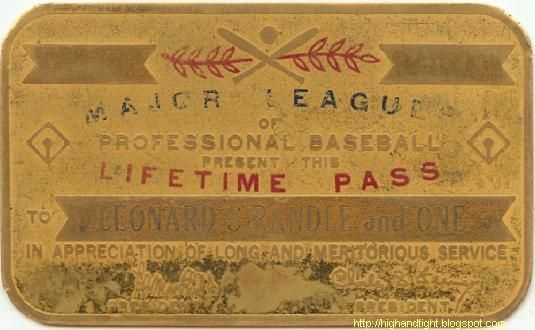
We've all heard Joe Morgan brag about his "Golden Ticket" - the lifetime pass that lets him into any MLB game for free. From what I've been able to find out, it's actually a lot more common than Mr. Morgan tends to let on. From what I can tell, any major leaguer with 10 years of service or more gets one. No special ceremony. No HOF induction required. Morgan's constant references to said ticket, however, seem to make it appear a bit more rare, which is kind of odd since in his frequent chats he constantly refers to not having seen enough of any team to form any sort of opinion about anything.
Here, for example, is a picture of one Golden Ticket, presented to Charley Root:

Here's another, more recent one, presented to journeyman middle infielder
Len Randle, who attended a Padres-Rockies contest with Dave Winfield last week, using said ticket for entry:
My guess is though, in Mr. Morgan's slipping memory, things went a bit like this (with apologies to
lupe for aping her style):

I wanted to be the first to find a Golden Ticket, Daddy.

I know, Angel. We're doing the best we can. I've got every girl on the bleeding staff hunting for you.
All right, where is it? Why haven't they found it?
Veruca, sweetheart, I'm not a magician! Give me time!
I want it now! What's the matter with those twerps down there?
For five days now the entire flipping factory's been on the job. They haven't shelled a peanut in there since Monday. They've been shelling flaming chocolate bars
from dawn to dusk.
Make 'em work nights.
(shouting down the stairs) Come along, come along, you girls, put a jack in it or you'll be out on your ears, every one of you! And listen to this: the first girl that
finds a Golden Ticket gets a one pound bonus in her pay bucket! What do you think of that?
(The workers scream and begin unwrapping more furiously.)
They're not even trying. They don't want to find it. They're jealous of me.
Sweetheart, I can't push 'em no harder. Nineteen thousand bars an hour they're shelling. Seven hundred and sixty thousand they've done so far.
You promised, Daddy! You promised I'd have it the very first day!

You're going to very unpopular around here, Henry, if you don't deliver soon.
It breaks my heart, Henrietta. I hate to see her unhappy.
I won't talk to you ever again. You're a rotten, mean father. You never give me anything I want. And I won't go to school 'til I have it.
Veruca, sweetheart, angel . . . Now. There are only four tickets left in the whole world, and the whole ruddy world's hunting for them. What can I do?

I got it! I got it, Mr. Salt, here it is!
It's about time too! I want it!

(Slugworth leads the worker up the stairs to Veruca.)
Give me that ticket! It's mine! I've found a Golden Ticket!
(Slugworth whispers in Veruca's ear.)
Thank God for that.
Aye. Happiness is what counts with children.
Happiness and harmony.
---------

Look, everyone, look, I've got it! The fifth Golden Ticket is mine!

You're pulling our legs, Charlie! There aren't any more Golden Tickets.
No, Grandpa, the last one was a fake; it said so in the papers. I found some money in the street, and I bought a Wonka Bar, and the ticket was in it.
Look at it, Grandpa, see for yourself!
"Greetings to you, the lucky finder of this Golden Ticket, from Mr. Willy Wonka. Present this ticket at the factory gates at ten o'clock in the morning of the first
day of October, and do not be late. You may bring with you one member of your own family but no one else. In your wildest dreams you could not imagine the marvelous surprises that await you!" Charlie, you've done it!
Grandpa? It says I can take somebody with me. I wish you could go.
(struggling to get out of bed) Charlie. (Charlie helps him.) Ah, that's good. Now help me up. (He stands, then falls back on the bed) Oh!
Are you okay?
Oh yeah, I'm fine, Charlie. (He stands up and stumbles.)
Look at me! Look at me! Up and about . . . I haven't done this in twenty years.
Grandpa!
------
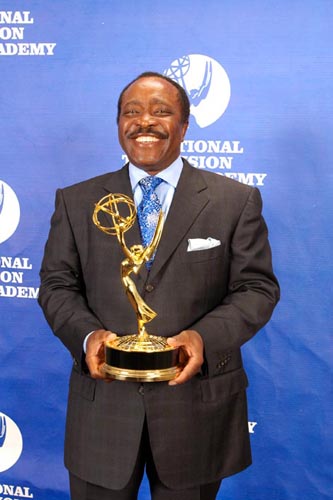
Then again, Morgan's gotten more gold than he deserves:
Labels: bud selig, dave winfield, gammo, golden tickets, joe morgan, john kruk, jon miller, lenny randle, screwing the blouse man
posted by Mr. Faded Glory @ 10:13 AM
2
comments





